



Clear APET looks premium on the shelf only while it stays clear. A tray window with hairline marks, or a folding-box panel scuffed in transit, reads as a quality problem even when the product inside is perfect. “Scratch-resistant APET” is the usual answer, but the phrase hides a real engineering choice: do you harden the surface, protect it temporarily, or stop the scratches from happening in the first place?
Quick answer
- Standard APET is a soft, glossy surface. It marks easily if rolls, tools or stacks are handled carelessly.
- Hard-coated PET is typically sold in the 1H–3H pencil-hardness class. Higher numbers exist, but they come from specialty films that are not designed for deep thermoforming.
- No coating makes plastic scratch-proof. Even suppliers of coated PET say so.
- If your part is deep-drawn, test the coated grade at your real draw ratio before committing. For many packages, a protective film plus clean tooling is the lower-risk route.
Why Plain APET Scratches
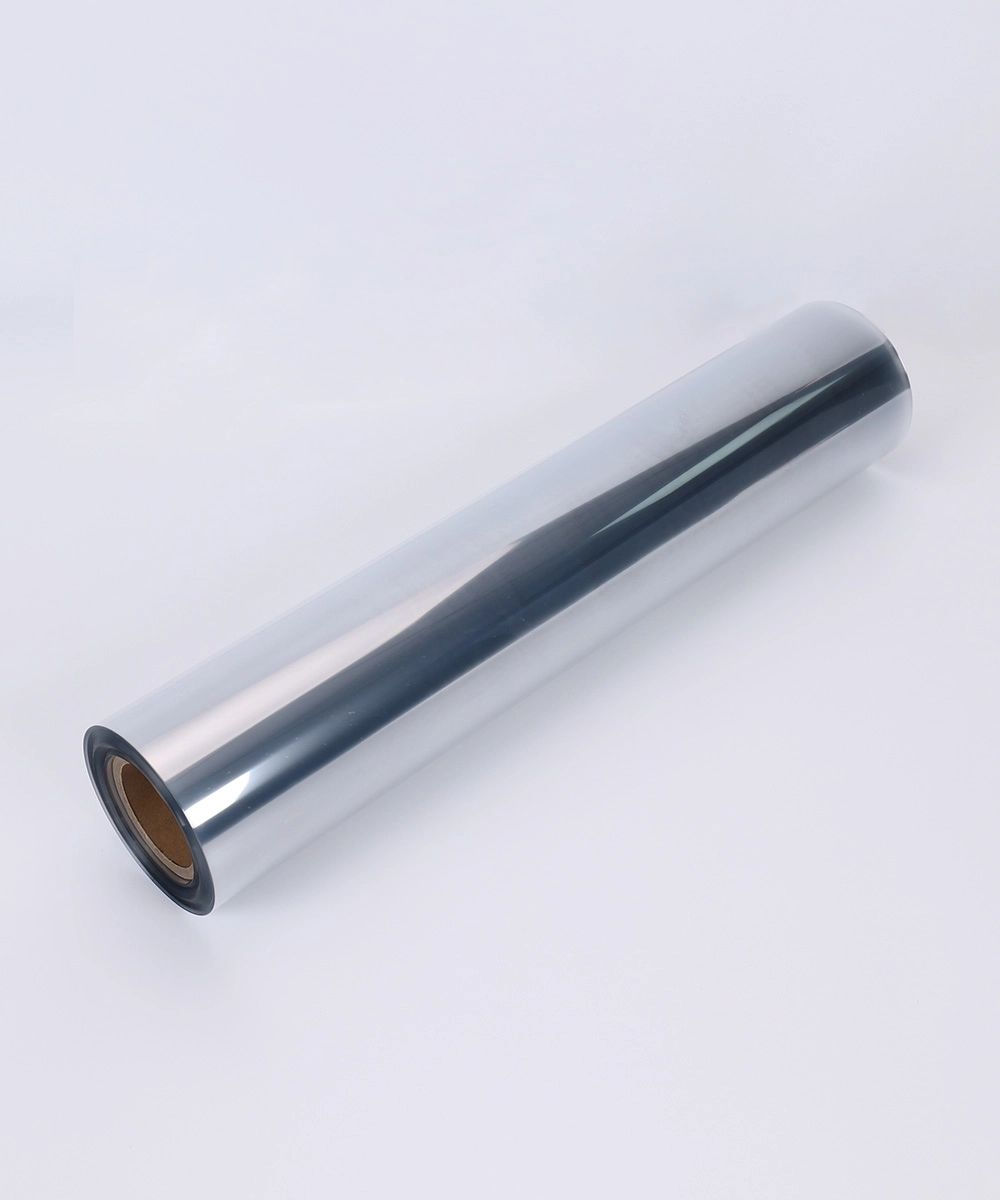
APET (amorphous polyethylene terephthalate) stays non-crystalline, which is why it transmits light cleanly and takes a high gloss. That same smooth, polished surface shows every defect. Common scratch sources in a converting line include roll winding and unwinding, contact with forming tools, die-cutting and stacking, hand contact, dust trapped between layers, and abrasive cleaning cloths. Mapping where your marks appear is the most useful first step, because the fix depends on where in the chain the damage occurs.
Three Ways to Get a Scratch-Resistant Surface
1. Hard-coated APET or PET
A thin, cured hard layer is applied to the sheet surface. Commercial anti-scratch PET sheet is described by one supplier as 1H–3H on the pencil scale with transparency of at least 90%, in thicknesses up to 1.8 mm. The same supplier cautions that the sheet is resistant, not scratch-proof, and should be kept away from abrasive materials.
2. Protective film or lamination
A removable film covers one or both faces during extrusion, slitting, forming and shipping, and is peeled off at the end. This does not harden the sheet; it keeps damage from reaching it. It is often the most practical choice when the sheet will be thermoformed, because the surface is never exposed to rollers, tools or stacking until the package is complete.
3. Process and handling control
Polished tooling, clean air handling, antistatic grades that attract less dust, interleaving and edge-only handling cost little and remove many marks at the source. Dust is not a trivial point: a particle trapped under a wiping cloth acts like sandpaper on a glossy surface. For the static-control options, see the supplier’s APET plastic sheets page.
How to Read Scratch-Resistance Claims
“3H” on a datasheet sounds precise. It is less precise than it looks. ASTM D3363 describes the pencil test as most useful for ranking coatings with clearly different hardness, advises caution when comparing coatings of similar hardness, and notes that results on softer substrates can reflect substrate deformation rather than coating hardness. A PET sheet is a comparatively soft substrate, so treat a pencil value as a relative index, not an absolute guarantee. Pair it with a test that measures what the customer actually sees: lost clarity.
ASTM D1044 does this by abrading a transparent plastic on a Taber abraser and quantifying the damage as the increase in haze compared with an unabraded sample, with haze measured per ASTM D1003. Gloss retention can be tracked with ASTM D523.
Table 1. Test methods and what each one tells you
| Test | What it measures | Watch out for |
|---|---|---|
| Pencil hardness (ASTM D3363) | Hardest pencil that does not mark or gouge the surface | Pencil brand and batch change results; soft substrates can distort the reading |
| Taber abrasion, haze change (ASTM D1044) | Increase in haze after a set number of abrasion cycles | Wheel type, load and cycle count must be stated or the number is meaningless |
| Haze and transmittance (ASTM D1003) | Light scatter and total light passing through | Measure before and after coating and after forming |
| Specular gloss (ASTM D523) | Mirror-like reflection at a stated angle | Compare only at the same angle |
| Cross-cut tape adhesion | Whether the coating stays bonded to the PET | Repeat on formed corners, not only on flat sheet |
The Hidden Trade-Off: Hardness vs. Thermoforming
This is where most scratch-resistance projects go wrong. Thermoforming stretches the sheet; a hard coating is a thin, stiff layer riding on a stretchable base. As a general engineering judgment (not a figure from any single datasheet), the harder the coating, the less it tolerates stretching, so shallow draws and flat panels are low risk while deep draws and tight corners deserve a trial. Some coating makers specifically promote flexible, thermoformable grades, which is a sign that not every hard coat is. Whatever the claim, check the formed part, not the flat sheet:
- Inspect corners and high-draw zones for crazing, whitening or lost gloss.
- Re-run haze and adhesion on formed samples.
- Heat the sheet evenly and avoid overheating, as sheet manufacturers advise for APET in general.
- Decide which face is the show surface and keep it away from the tool, as covered in our high-gloss APET buyer’s guide.
Which Approach Fits Your Application?
Table 3. Matching the solution to the use case
| Application | Main scratch risk | Suggested starting point |
|---|---|---|
| Flat display windows, folding-box panels | Retail handling, stacking, wiping | Hard-coated sheet in the 2H–3H class; little forming stress |
| Deep-draw clamshells and trays | Tool contact, trimming, nesting | Protective film through forming and trimming, polished tools; trial any coated grade at full draw |
| Electronics trays and carrier materials | Dust, component abrasion, static | Antistatic or conductive grade; see APET carrier tape sheets |
| Chilled food packs | Condensation plus handling | Anti-fog APET; confirm any extra surface coating does not interfere with the anti-fog layer |
| Printed or decorated panels | Ink scuffing, surface wear | Check ink adhesion on any coated face; see the printable APET guide |
Hongkai’s APET Base Sheet: What Is Published
Haining Hongkai Technology Co., Ltd., founded in 2018, produces PET, ABS and PS thermoforming sheets on two lines with a stated output of 700 tons per month, and states ISO 9001 and ISO 14001 certification. Its APET plastic range includes standard, antistatic and conductive sheet, plus anti-fog, UV-resistant, colored, R-PET, BIO-PET and C-PET variants. The published base-sheet parameters are below.
Table 4. Published APET base-sheet parameters (Hongkai)
| Parameter | Published value | Why it matters for scratch control |
|---|---|---|
| Thickness | 0.2–1.3 mm (±0.015 mm) | Even gauge keeps forming and any coating or film behavior consistent |
| Width | 300–1000 mm (±1.0 mm) | Match to tooling to cut trimming and handling steps |
| Density | 1.35 g/cm³ (±0.02) | Material consistency across lots |
| Maximum roll weight | 550 kg | Heavy rolls need careful unwinding; edge crush and layer slip cause scuffs |
| Surface resistance (normal / antistatic / conductive) | ≥1012 / 109–1011 / 104–108 Ω | Lower resistance means less dust attraction, which reduces micro-scratching |
Transparency note: the published APET pages do not list a pencil-hardness value or a dedicated hard-coated grade. If you need a specific hardness class or abrasion result, send your requirement with a sample drawing so the technical team can confirm what can be supplied and tested, instead of assuming a figure.
Handling Checklist That Prevents Most Marks
- Keep rolls wrapped and store them clean, dry and off the floor.
- Keep the protective film on until the last step before filling or display.
- Polish and clean forming tools; a dull or dirty tool transfers marks.
- Use interleaving or separators for stacked formed parts.
- Clean with a soft, lint-free cloth and a mild cleaner; avoid abrasive pads and powders.
- Log where marks first appear so you know which control to tighten.
What to Put in Your RFQ
- Base sheet: thickness, width, grade (normal, antistatic, conductive, anti-fog, UV, colored).
- Hardness target with method: ASTM D3363, pencil brand, load and the pass criterion.
- Abrasion target: ASTM D1044, wheel type, cycles and maximum allowed haze increase.
- Optical limits: minimum transmittance, maximum haze, gloss angle and value.
- Which face must be protected, and whether protective film is required on one or both sides.
- Forming details: machine, draw depth, temperature window, tool finish.
- Compliance needs: food contact, RoHS for electronics, and any recyclability claims, since a surface coating may need to be assessed against those claims in your market.
Frequently Asked Questions
Is scratch-resistant APET the same as scratch-proof?
No. A hard coat raises resistance to light abrasion; sharp objects and rough surfaces can still mark it.
What does 3H mean?
It is a pencil-hardness grade: a 3H pencil did not mark the surface under the test conditions. It ranks surfaces; it does not predict real-world wear, so request abrasion and haze data too.
Can a hard-coated sheet be thermoformed?
Some suppliers state that their grades can be. Confirm on your own tool at your real draw ratio, and re-test haze and adhesion on the formed part.
Does a protective film or an antistatic grade help?
Both address the handling stage, where much of the damage is done. The film shields the surface; an antistatic grade reduces dust attraction.
Can I order scratch-resistant APET from Hongkai?
The company offers customized APET sheet, and hardness or abrasion requirements are best handled as a quoted specification. Contact the team with your drawing, volumes and test targets.